
Voltage used in Alarm Systems
Voltage is the electrical force that moves electrons through a conductor. In the previous post, we learned that voltage is the pressure in a circuit, current is the flow, and resistance is the opposition that controls that flow. This article focuses on how voltage is managed in alarm systems and why the correct supply voltage is critical.
Voltage is the electrical potential difference between two points in a circuit. It represents the force that pushes electrons through wires and components.
What is voltage?
Voltage is the potential difference between two points. It is represented by the symbol V and is measured in volts.
Real-world analogy
If electricity is water, voltage is the pressure pushing that water through a pipe. The higher the voltage, the more force is available to move current through the circuit.
Voltages used in alarm systems
Alarm panels normally use two different voltage sources:
- AC input: typically, around 16 VAC to 18 VAC, depending on the manufacturer.
- DC output: the panel converts AC to DC and supplies about 13.5 V to 13.7 V DC to alarm devices.
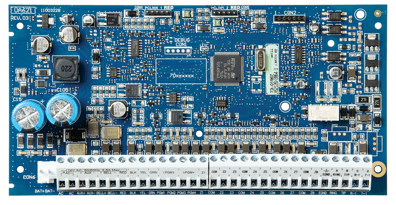
This DC output is often called AUX or AUX output on the panel circuit board (AUX+/AUX-).
Types of Voltage
- AC vs DC — Alternating current (AC) changes polarity periodically (used for mains and transformer inputs). Direct current (DC) flows in one direction and powers most alarm peripherals.
- Peak vs RMS — AC peak is the maximum instantaneous value; RMS (root mean square) is the effective value used for power calculations. For example, 230 V RMS mains has a higher peak value.
- Common household values — Varies by country. Example: Australia/South Africa mains are 230 V (nominal RMS).
Measuring Voltage
- Multimeter basics — Use a digital multimeter set to the correct range (VAC for AC, VDC for DC). Measure across the two points of interest (e.g., AUX+ and AUX-).
- Safety tips — Turn off circuits when possible, use insulated probes, keep one hand behind your back when probing mains, and follow local electrical regulations.
- Typical readings — AUX outputs typically read ~13.5–13.7 V DC at the panel; AC transformer input may read ~16–18 VAC unloaded.
Common Misconceptions About Voltage
- “Higher voltage means more power” — Power depends on both voltage and current (P = V × I). Higher voltage alone does not guarantee more power.
- “Voltage is dangerous by itself” — Voltage is the cause of potential electric shock, but harm depends on current through the body and exposure path; both voltage and circuit conditions matter.
The system also includes a battery terminal responsible for charging batteries and supplying power during an outage. The battery connector provides a DC voltage that charge the batteries and use the battery in case of a power failure. This terminal is used to charge batteries only. The AC is the 16Vac voltage source that powers the panel, and the AUX terminal is a DC voltage output terminal used to power peripherals.
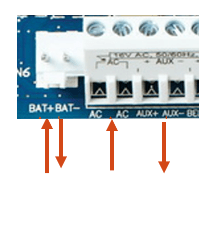
We use the 13.7Vdc to supply power to sensors devices and power modules on the system. The supply voltage is called Aux output (AUX+/AUX-) on PCBs. The output is limited in its supply, and is also regulated, meaning that the voltage under normal operating conditions will be stable. It’s important that we connect the terminals correctly here, since they have a dedicated + (positive) terminal and – (negative) terminal. Although the output on most panels is protected against short circuits and swapped polarity, not all equipment is equal in this regard.
Most older systems make use of a fuse to protect the circuit, and if you blow the fuse do not replace it with anything that is not designed or rated for the holder slot. If your fuse blows look for a similar rated fuse. it is essential to replace it with a one that matches the original design and rating for the holder slot. Do not use anything else like soldering wire, aluminium paper, electrical cable
Real-World Examples
- Batteries — Provide DC voltage (common alarm backup batteries are 12 V series configurations).
- Chargers / power supplies — Convert mains AC to regulated DC (AUX) for the panel and batteries.
- Solar systems — Produce DC that must be regulated and matched to battery/storage requirements.
- Electronics — Sensors, keypads, and communicators are designed for specific DC AUX voltages.
Why voltage matters
If the voltage is too low, devices may not function correctly. Sensors may fail to report, chimes may not sound, and the panel can generate false alarms. If the voltage is too high, devices can overheat or be damaged. Proper regulation and correct wiring are essential.
Voltage drops and long cable runs
Long cable runs increase resistance and cause voltage drop. Even if the panel is supplying the correct voltage, the device at the far end may receive less voltage than it needs. Use thicker wire or shorter runs to reduce voltage drop, especially for devices that draw significant current.
Battery charging and backup power
Alarm systems include battery terminals for charging backup batteries and supplying power during outages.
- The AC source powers the panel and charges the battery.
- The battery terminal provides DC voltage to recharge the battery and to power the system when AC fails.
- The AUX terminal powers sensors and peripherals while the panel is online.
When AC fails, the AUX voltage may fall toward the battery cutoff level. Many systems use 10.5 V DC as the battery cutoff threshold to protect the battery and the system.
Connecting the battery and AUX output correctly
Most panels have separate positive (+) and negative (-) terminals. Correct polarity is vital.
- AUX+ / AUX-: powers sensors, detectors, and other peripherals.
- BAT+ / BAT-: charges and supports the backup battery.
While many panels include short-circuit and reverse-polarity protection, not all connected devices tolerate mistakes. Always wire terminals correctly.
Fuses and protection
Older alarm systems often use fuses to protect the auxiliary and battery circuits.
- If a fuse blows, replace it only with the same type and rating.
- Do not substitute solder, aluminum foil, or other materials.
- Use a fuse designed for that holder slot and panel.
Summary
Voltage is the pressure that makes current flow. In alarm systems, stable DC voltage from the AUX output and proper battery charging are essential for reliable performance.
- Represented by the symbol V
- It is measured in Volts
- AC input voltage can be 16Vac to 18Vac, depennding on the manufacturer of the alarm system.
- Alarm systems uses 13.5 to 13.7Vdc – Supplied from the panel to sensor devices
- Note when AC fails this Voltage can go as low as 10.5Vdc
- 10.5Vdc is the cutoff voltage for the battery – This is to protect the
- Voltage is the pressure that pushes electrons; measure it correctly and protect circuits.
- Voltage is the pressure.
- Current is the flow.
- Resistance is the load the devices present.
Keeping the voltage within the correct range, wiring the correct polarity, and protecting circuits with fuses are the best ways to ensure alarm system reliability.