
Resistors
Resistors have an apt name: They “resist” the electrical current going through them. You can think of resistors as “brakes” for electrons. By controlling the electrons going through a resistor, you can make a circuit do different things. Resistors may be the primary building block of circuits, so you see them quite a bit in electronics projects. Here are some of the things you can use them for:
- Limiting current
- Reducing Voltage in part of a circuit
- Controlling voltage and current going into another component
- Protecting the inputs of sensitive components
Resistance
The amount of resistance in a resistor is represented by the Greek capital letter omega. The higher the ohm value of the resistor, the more resistance the resistor provides. To understand how you can adjust resistance in a circuit, you should know that there are two types of basic resistors. Fixed and Variable. We use fixed value resistors for our application.
Alarm systems
In Alarm systems, a End of Line resistors is used to terminate each zone. Each zone on the system is supervised, meaning that the system continuously check that each device connected to the input on the main board ( the system) and expects to see the value of the resistor for the system on each zone input. The value depends on the manufacture, but values like 5K6 and 3K3 are normally used for the supervision purposes.
On some systems, the value can be programmed, so any resistor can be a EOL (End of line) resistor. EOL resistors are also used in alarm systems to protect the system against short-circuits or voltage fluctuations. These resistors are connected in series at the end of each alarm zone, typically at the last device in the circuit, such as a motion sensor or door contact. The EOL resistor helps to establish a stable voltage level in the circuit and ensures that the alarm control panel can accurately detect an alarm condition. In the event of a short circuit, the EOL resistor helps to protect the control panel by limiting the flow of current, preventing damage to the system and ensuring reliable operation.
What do resistors do in a circuit?
- Resist the flow of electrical current.
- The higher the resistance
- The lower the current
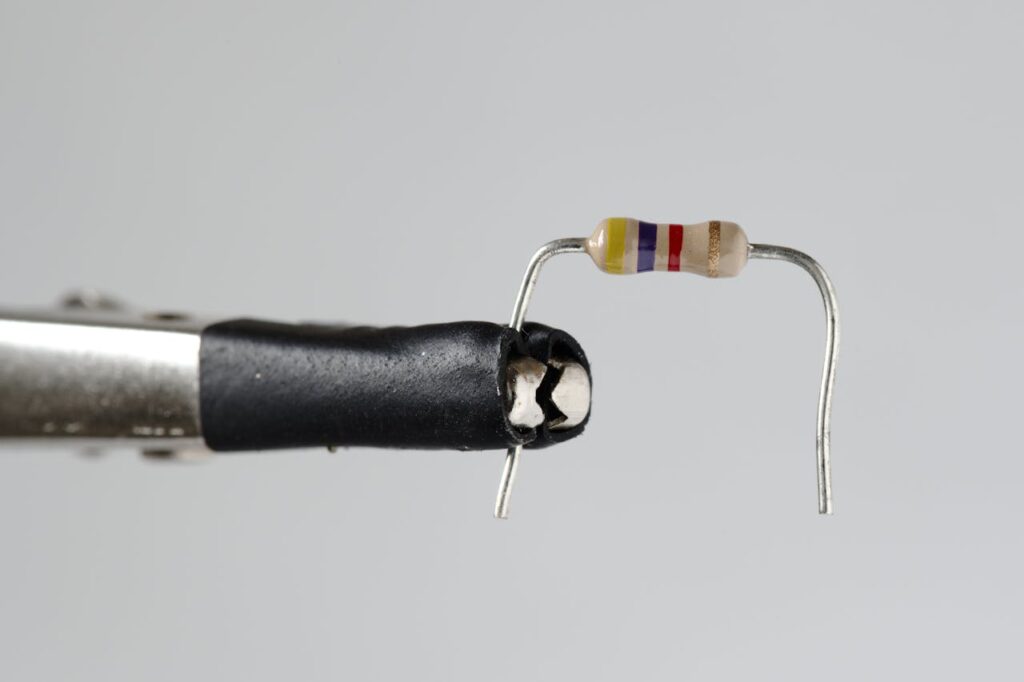
Reading Resistors
Not all resistors use color coding. Sometimes the value is printed on the resistor. For most other cases resistors are colour coded for easy reading. Resistors colour codes are used to identify the resistance value of a resistor and its tolerance. The colour coding makes it easier for manufacturers and engineers to identify the value of a resistor without having to measure it with a multimeter or other testing equipment. The standard colour code consists of four or five bands, each representing a different digit of the resistance value, the tolerance and sometimes the temperature coefficient. The colour bands are arranged in a specific pattern, allowing the user to quickly determine the resistor value. This method of identification is quick, reliable, and consistent, making it a standard in the industry.
Standard-precision resistors use four color bands. These resistors come within at least 2 percent of their marked value. That is, the markings on the resistor and the actual value of the resistor when you test it fall within at least 2 percent of one another. You use standard-precision resistors for 99 percent of projects. High-precision resistors have five colour bands, and they come within 1 percent or less of their marked value. To read the value, Rotate the resistor
- To determine the value of a resistor
- Look at the gold or silver tolerance band
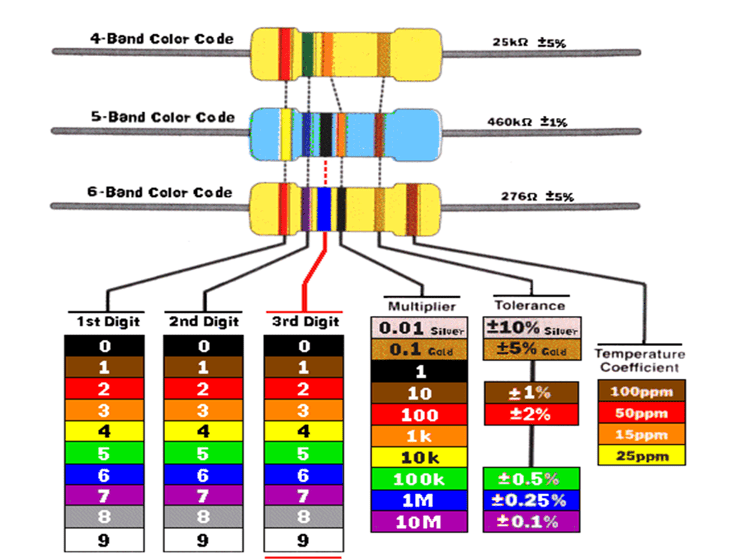
Resistors are colour codes for easy reading, but in some cases, it might still be required to use a multimeter to read their value. To determine the value of the resistor:
- Look at the gold or silver tolerance band. To subtract the value of your final calculated value to determine a lower and upper limit for the resistor value.
- Make sure the Tolerance band is on your right.
- Read the values as per the sheet above, starting from left to right. 5K6 – Green, Blue, multiplier 2 (10 to the power 2) = 5600 ohms = 5K6
- Add and subtract the value of the tolerance band to the value of the resistor to determine a range of possible of values. (5600-10%, 5600+10%) – 10percent tollerace ban would be Silver