
Connecting batteries
Battery is often grouped together, in Series to increase the voltage (In series the voltages add), and in parallel to increase the capacity (In parallel the currents add) and the voltage remains the same. The capacity of the battery increases as the number of cells in parallel increases, allowing the battery to store more energy and deliver a higher current.
Battery Cells are often grouped together:
- In Series to increase the voltage
- In series the voltages add…
- In parallel to increase the capacity
- In parallel the currents add
and the voltage remains the same. The capacity of the battery increases as the number of cells in parallel increases, allowing the battery to store more energy and deliver a higher current. Connecting cells in parallel is a common way to increase the capacity of a battery, especially for applications that require high current delivery or longer run times.
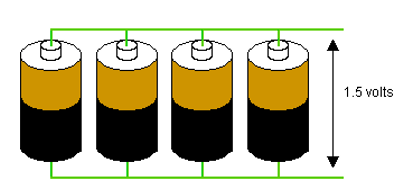
In a Parallel arrangement.
- Each battery produces 1.5 Volts
- Four batteries in parallel still produces 1.5 volts.
- But with 4x the current of a single battery
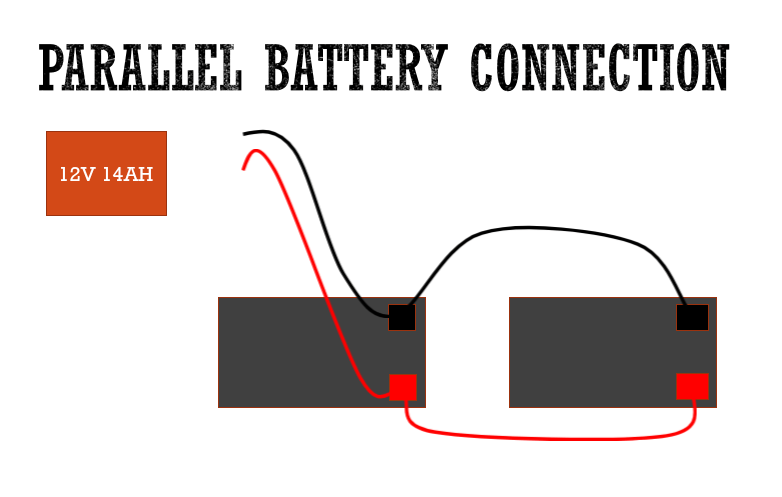
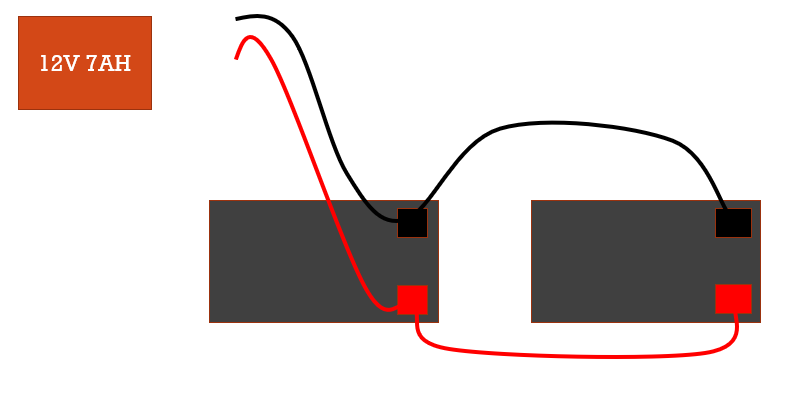
Parallel Battery connection for Alarm panel
A parallel battery connection for an alarm panel refers to a configuration in which two batteries are connected to the alarm system in a way that they are parallelly linked to each other, with both their positive terminals connected to the same positive conductor and their negative terminals connected to the same negative conductor.
This configuration increases the overall capacity of the battery system, allowing the alarm system to operate for longer periods during a power cut or power failure. However, it’s important to make sure that the batteries used in a parallel connection are of the same type, capacity, and voltage, as connecting batteries of different specifications can cause an imbalance and damage the battery system.
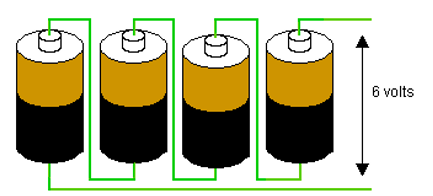
In a Serial arrangement.
- Voltages adds together to 6 Volts
- Four batteries in serial still produces 6 volts.
- But the same current as a single battery.
- Serial Battery connection for Alarm panel
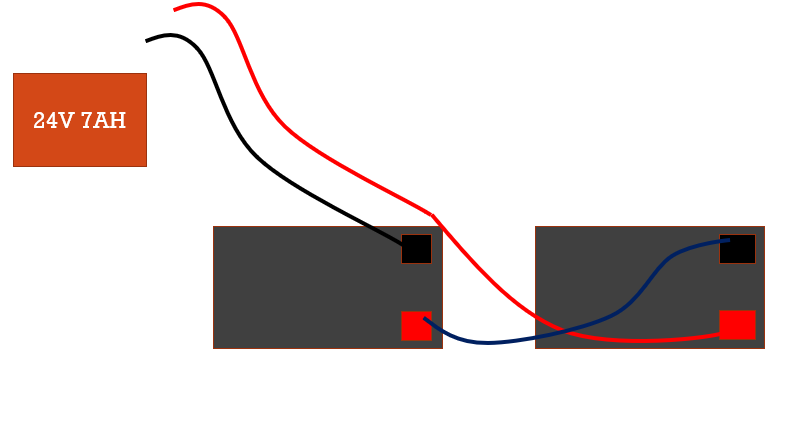
When connecting batteries in series, the voltage of each battery is added together, while the capacity remains the same. This configuration is often used in Fire Detections systems to increase the overall voltage of the system to 24V.
When connecting batteries in series, it is important to ensure that each battery has the same voltage and capacity, and that the polarity is correct. The positive terminal of one battery should be connected to the negative terminal of the next battery in the series. This way the voltage adds up but the current capacity remains the same.
Open circuit voltage of lead-acid cell is about 2.29V
- Times this by 6….
- A 12 Volt battery has about 13.74 volts!
This is a rough estimate, as the open circuit voltage of a lead-acid cell can vary based on a number of factors, including the state of charge, temperature, and age of the battery. In general, the open circuit voltage of a lead-acid cell is about 2.2-2.3V, and for a 12V battery, the nominal voltage is typically around 12.6-12.8V, but this can also vary based on the manufacturer and specific battery type. The voltage on the battery with the alarm system charging the batteries is around 13.7Vdc
FAQ
Q: What happens when you connect batteries in series?
A: Series wiring increases the total voltage while keeping the capacity (Ah) the same.
Q: What happens when you connect batteries in parallel?
A: Parallel wiring keeps the voltage the same but increases the total capacity (Ah).
Q: Can you mix different battery types in series or parallel?
A: No. Mixing different chemistries, ages, or capacities can cause overheating, damage, or failure.
Q: Can connecting batteries incorrectly cause damage?
A: Yes. Incorrect wiring can cause short circuits, overheating, or battery rupture.
Q: Which is better: series or parallel?
A: Series is best when you need higher voltage; parallel is best when you need longer runtime. For alarm systems, Parallel is best.