
Current in Alarm Systems
Current is the flow of electric charge through a conductor. In the previous blog post, we learned that voltage is the pressure and resistance is the opposition to that flow. This article expands on current and explains how it behaves in alarm systems, how to measure it, and how to avoid common mistakes.
What Is Electrical Current?
Current is the amount of charge moving past a point in a circuit each second.
- Symbol: I
- Units: amperes (amps, A)
- Common smaller unit: milliamps (mA), where 1 A = 1000 mA
Electron flow explained
Current is carried by electrons moving through a conductor. In a copper wire, the electrons themselves move slowly, but the effect of current flows quickly through the circuit.
Why current matters
Current determines how much energy devices consume and how quickly batteries charge. In alarm systems, the available current defines how many sensors, sounders, and accessories can be powered reliably.
How Current Flows in a Circuit
Current travels from the source, through the load, and back along the return path.
- Source: the power supply or battery.
- Load: the device using the current, such as a sensor, keypad, or siren.
- Return path: the negative or neutral conductor completing the circuit.
AC vs DC current
- DC current flows in one direction and is used by most alarm peripherals.
- AC current alternates direction and is used for mains power and transformer inputs.
Real-world analogy
If voltage is the pressure, current is the water flowing through the pipe. The source pushes the water, the load uses it, and the return path carries it back.
Measuring Current
Multimeter basics
To measure current, set your digital multimeter to the correct current range and place it in series with the circuit. The current must flow through the meter.
Series measurement
Disconnect the circuit at the point you want to measure, then connect the meter between the two points. Do not measure current by placing the meter across a voltage source.
Safety tips
- Turn off power before changing meter connections.
- Use the correct current input jack and fuse-protected range on the meter.
- Keep fingers behind probe guards and avoid touching bare conductors.
Current Formula (Ohm’s Law)
Ohm’s law relates current to voltage and resistance:
I = V/R
Example calculation
If a 12 V supply feeds a device with 120 Ω resistance, then:
I = V/R= 12 / 120 = 0.1A = 100mA
Practical alarm system example
A motion sensor rated at 20 mA on the AUX circuit draws 0.02 A. If the panel can supply 1 A, you can run up to 50 such sensors before reaching the panel limit.
Types of Current in Electronics
- AC — Alternating current reverses direction periodically.
- DC — Direct current flows in one direction.
- Ripple current — Small AC variations riding on top of a DC output, often seen in power supplies.
Common Misconceptions
“Current is stored in a battery”
Batteries store energy in chemical form. Current is the flow produced when the battery is connected in a circuit.
“Higher current is always dangerous”
Current can be dangerous at high levels, but the danger depends on the path through the body and the circuit conditions. In electronics, higher current may be necessary and safe when properly controlled.
Real-World Examples
Alarm systems
Alarm sensors, keypads, and communicators all draw current from the panel’s AUX output. The total current load must be calculated to ensure reliable operation.
CCTV power supplies
CCTV cameras typically require DC power and draw significant current, making correct power supply sizing important.
Current in Alarm Systems
Current depends on both voltage and resistance, as described by Ohm’s law. In an alarm panel:
- The AUX output provides DC voltage to sensors and peripherals.
- Each device draws a specific current based on its resistance and operating voltage.
- The panel and wiring must supply enough current without exceeding rating limits.
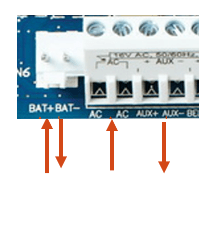
Current limits on alarm systems
- Older panels often limited AUX output current to around 550 mA.
- Newer panels may provide 700 mA to 1000 mA or more on battery charger and AUX circuits.
- The actual available current depends on the panel design and the settings for battery charging.
Older Alarm systems had a current limitation of around 550mA on their AUX terminals, and the batteries could only be charged around 500mA. If you have a newer alarm system, you can expect anything from 700mA to a 1000mA on your battery connector terminals to charge batteries. Most panels have a high current setting that supplies a higher current rating to charge the batteries.
Power budgeting
For your AUX terminals, you cannot keep adding devices without calculating the total current draw. Additional power supplies may be required if you plan to draw more than the available current.
Battery Charging and Current
When charging batteries, current determines how fast energy flows into the battery. While voltage provides the pressure, current controls the actual charging rate.
- Insufficient current leads to slow or incomplete charging.
- Excessive current can overheat or damage the battery.
- A well-regulated charger protects battery life and system performance.
Alarm system chargers are designed for specific battery sizes and types. Do not use larger batteries like car batteries or batteries that are not specified for the system.
Summary
- Electrical current is the flow of electrons, measured in amps.
- Current in a circuit travels from source to load and back along the return path.
- Ohm’s law links current to voltage and resistance.
- In alarm systems, current limits determine how many devices can be powered from AUX outputs.
- Always measure current in series, follow safety procedures, and budget the total load.
Related articles
- The output current is limited according to the specification of the alarm system.