
Semiconductors and Their Role in Alarm Systems
Semiconductors are the foundation of modern electronics. Neither perfect conductors nor perfect insulators, semiconductor materials (such as silicon) can be engineered to behave as either by controlling impurities (doping) and applied voltages. This tunability makes them ideal for diodes, LEDs, transistors, and the integrated circuits inside alarm control panels.
How semiconductors are used in alarm systems
- Switching — Semiconductors switch current on and off with no moving parts, making them reliable and fast for controlling relays, sirens, and indicators.
- Signal conditioning — Transistors and diodes amplify and shape sensor signals so the control board can interpret them reliably.
- Indicators and interfaces — LEDs and small logic circuits provide status lights and drive communications to user interfaces or apps.
Diodes and LEDs
Diodes allow current to flow in one direction and protect circuits from reverse voltage. LEDs (light-emitting diodes) are diodes designed to emit light when forward-biased. They are compact, efficient, and commonly used as status indicators on alarm panels.
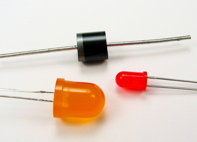
Practical LED guidance
- Forward current and peak current: An LED’s datasheet lists a recommended forward current (typical operating current) and a higher peak current (allowed for short pulses only). Exceeding these ratings will damage the LED.
- Forward voltage: LEDs have a forward voltage drop that depends on color and construction (commonly ≈ 1.8–3.3 V for visible LEDs).
- Use a series resistor: Always place a resistor in series with an LED to limit current. Calculate the resistor using Ohm’s law:
Quick resistor guidelines (starting values)
- 3.3–5 V supply: 330 Ω
- 6–9 V supply: 560 Ω
- 12–15 V supply: 1 kΩ
These are conservative starting values. For precise brightness or maximum lifespan, use the LED’s forward voltage and your target current to compute forward resistor value.
Transistors in alarm systems
Transistors act as amplifiers and electronic switches. Typical uses in alarm panels:
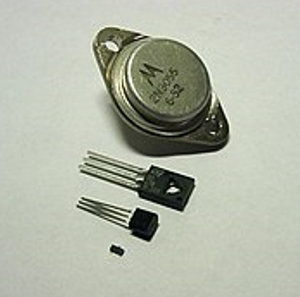
- Drive relays, sirens, or other high-current devices by switching currents greater than the control logic can handle directly.
- Amplify weak sensor signals so the control circuitry can detect events reliably.
When using transistors:
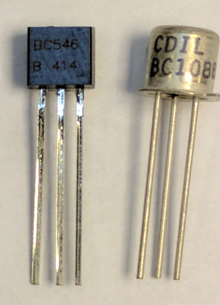
- Select a transistor with appropriate voltage and current ratings for the intended load.
- Use a base (BJT) or gate (MOSFET) resistor to limit drive current.
- For inductive loads (relays, motors), include a flyback diode or snubber to protect the transistor from voltage spikes.
Polarity and precautions
- Polarity sensitivity: Many semiconductor parts (LEDs, diodes, polarized capacitors, transistors) are polarity sensitive. Reversing polarity can destroy the component.
- Current limiting: Never omit the series resistor for LEDs. Connecting an LED directly to a supply that exceeds its ratings will likely burn it out.
- Protection: Use fuses, current-limiting resistors, snubbers, and flyback diodes where appropriate to protect both components and the rest of the system.
Installing and retrofit notes
- Indicator placement: Visible LEDs outside a building can reveal the alarm’s status. Consider discreet/internal indicators or remote status via an app for better security.
- Compatibility checks: When adding LEDs or sensors to an existing panel, verify supply voltage, polarity, and expected current draw before wiring.
Conclusion
Semiconductors—diodes, LEDs, and transistors—are central to modern alarm-system design. They make circuits smaller, faster, and more reliable than older electromechanical components. With basic precautions (correct polarity, proper resistor sizing, and protection for inductive loads), you can safely use semiconductor components to build or retrofit alarm electronics.
Watchouts: polarity mistakes, omitted current-limiting resistors, and incorrect component ratings are the most common causes of failures. Always consult datasheets before connecting parts.