
How Batteries work
Batteries power everything from small electronics to alarm systems. Understanding how they work helps you choose the right type and avoid common mistakes.
A battery has two terminals, a + positive terminal, and a – negative terminal.
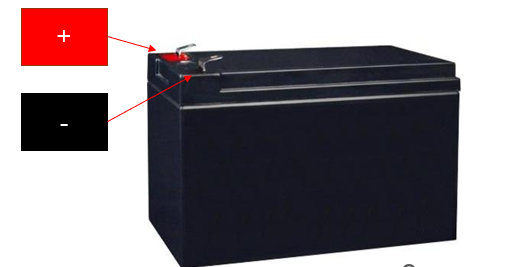
Different sizes and shapes can be constructed using cells, so their sizes and shapes can vary greatly. Never short out battery terminals – the battery could explode in your face, and you could lose your sight if you get chemical burns! (If a wire is connected directly between the terminals without a load, meaning that there is a low resistance with a large current flowing through the wire.)
Batteries are energy storage devices that are composed of two dissimilar metals immersed in an acidic solution. For alarm systems, Sealed Lead Acid batteries are commonly used. However, in instances of shortage in battery stock, it is possible that an incorrect battery with a different terminal size may be sold by alarm suppliers.
Make sure you buy the correct battery intended for the system with the correct AH specification. Alarm System use anything from 7Ah to 8AH depending on the built in battery charger. Some panels also allow to select a charging mode, like select low or high current charging.
Battery types for Alarm Systems
Common type of battery types for alarm systems:
- Lead Acid
- Anti Glass Matt (AGM)
- Lithium (Lithuim-ion Phosphate)
However, it is important to note that terminal sizes can vary depending on the specific application. To ensure proper performance, it is recommended to procure batteries from reputable suppliers who supply the appropriate terminal size. Most reputable suppliers get the correct batteries for the application, but during shortages of battery stock it has happened that the incorrect battery terminal size has been sold from alarm suppliers.
- Alarm systems use 4 mm lugs.
- UPS systems use 5 mm lugs or bigger on their terminals (Rule of thumb)
Cutting off terminals on battery leads can void the alarm system’s warranty and compromising the integrity of the connection. Alarm suppliers may sometimes provide incorrect battery terminal sizes, especially during stock shortages, but modifying the leads is not the solution.
Instead, it’s important to ensure that the correct terminal connectors are used. Using the proper connectors ensures a secure electrical connection, reduces the risk of system faults, and keeps the setup neat and organized. If the terminals do not fit, purchasing an adapter or a suitable terminal connector is a safer alternative than cutting or modifying the leads.
Always follow manufacturer guidelines to maintain system reliability. Some manufacturers will void your warranty if any changes are made to their boards, even for something as trivial as cutting and modifying battery charge leads.
How to work with Batteries
A battery has two terminals
- + positive terminal
- and a – negative terminal
Note that different sizes and shapes can be constructed using cells, so their sizes and shapes can vary greatly. Never short out battery terminals – the battery could explode, and you could get extreme chemical burns! If a wire is connected directly between the terminals without a load, meaning that there is a low resistance with a large current flowing through the wire. What will Happen.
- Current will flow from + to -.
- This will wear the battery out quickly, because we are exceeding the discharge current requirements for the battery in question, especially if it is a prolonged short.
- Heat is dissipated in the wire because of high current flow. Your hands may receive serious burns if exposed to the wire.
- This is extremely dangerous!! under the right wrong conditions, you can get serious burns to your hands and face.
Short Circuit on a battery
Short circuits differ depending on the battery type. The bigger the battery the bigger the chances of getting serious injuries, or explosions. What happens when you cause or create a direct short over your battery terminals.
- Heat is dissipated in the wire because of high current flow, which is causing the short.
- Heat is also produced in the battery and dissipated internally. Depending on the battery type that battery can trigger a thermal runaway, which leads to a fire or explosion.
- The casing might bulge or crack or rapture. Leaks may occur.
- Permanent Battery failure
- This is very dangerous, and now you must dispose of a battery that might or might not recycled….
- Do not do this.
Other Items that can cause a short, and cause accidents while working with batteries
- Jewelry
- Screwdrivers
- Fluids
A load needs to be connected to the battery with the wire. A load might be a light bulb, a motor, and electric circuit etc. In the battery, current is produced by chemical reactions inside the enclosure.
- Chemical reaction is called the battery’s internal resistance.
- The reaction only start when the circuit is formed.
Batteries performance is measured by:
- Voltage:
- Determined by the materials used
- Acid concentration
- Capacity:
- Dependant on the quantity of active materials contained
- Measured in ampere-hours
This performance test is conducted over a 20 hour period.
Cells
- A cell contains two plates in an electrolyte
- A chemical reaction produces E.M.F (Voltage) between plates.
- Cells can be divided into two different categories:
- Primary Cells (Non-rechargeable)
- Secondary Cells (Rechargeable)
Primary cells, also known as disposable cells, can only be used once as the chemical reaction that produces voltage cannot be reversed. They have a limited lifespan and once their energy is depleted, they must be disposed of properly. Examples of primary cells are alkaline batteries and carbon-zinc batteries.
Batteries consist of one or more cells.
Secondary cells, also known as rechargeable cells, can be recharged multiple times as the chemical reaction can be reversed. They have a longer lifespan compared to primary cells but their performance decreases over time with each charge-discharge cycle. Examples of secondary cells are Lithium-ion batteries and Nickel-Metal Hydride (NiMH) batteries.
Primary Cells:
- Can only be used once – can not be recharged.
- Chemical reactions supplying electrical current are irreversible.
Secondary Cells:
- Rechargeable
- Cells chemical reaction reversed when charging current passed through it.
Charging Secondary cells
Charging of secondary cells involves the transfer of electrical energy into the battery to increase the voltage of the cells, by injecting current into the battery, and raising the Voltage of Battery. The charging process should be done in accordance with the manufacturer’s specifications and guidelines, as improper charging can lead to reduced battery life and performance. On a wet Cell/Battery, the battery can start boiling if overcharged. When charging a secondary cell, the following should be considered:
- Charge rate: The charge rate should be appropriate for the battery type, as specified by the manufacturer. A higher charge rate will result in a faster charge, but may also cause the battery to overheat, reducing its life.
- Voltage limit: The voltage limit should not be exceeded, as this can cause damage to the battery and reduce its life.
- Temperature: The battery temperature should be monitored during charging, as overheating can cause damage to the battery and reduce its life.
- Charging time: The charging time will depend on the battery type and capacity, as well as the charge rate. The charging time should be monitored, and the battery should be removed from the charger once it is fully charged.
When charging secondary cells, it’s important to use a charger that is specifically designed for the type of battery being charged and to follow the manufacturer’s recommended charging procedure and specifications. Overcharging or undercharging a battery can reduce its performance and lifespan. It’s also important to monitor the charging process to ensure that the battery is not being overcharged or charged too quickly, which can cause damage to the battery or reduce its performance. Alarm systems have built-in charging that handle and manages the process for you.
- It is important to follow manufacturer charging specifications.
- The rating of a battery:
- Rated in Ampere/ hours or Amp/Hours (A/H)
- A fully charged battery rated at 7A/H should provide:
- 1 amp of current to a circuit for 7 hours
- 7 Amps of current to the same circuit for 1 hour.
- Discharge curves are not linear, so keep in mind we will not draw 7amp from a 7AH battery.
- 1A for 7 hours or ***2A for 3.5 hours, etc.
- It’s important to note that discharge rates can vary based on operating conditions, so it’s always best to consult the manufacturer’s specifications for accurate information. a 2A draw from a 7AH battery, will be for short durations and not a long sustained current draw.
Discharge curves refer to the graphical representation of a battery’s voltage and discharge rate over time, indicating how much energy the battery can supply over a given period of time. Discharge curves are used to evaluate battery performance and are important in determining the suitability of a battery for a specific application. The discharge curve is not always linear and can vary depending on the type of battery and its usage, so it’s important to use the information as a general guide and not rely solely on it.
Conclusion
Whether you’re powering a gadget or maintaining an alarm system, knowing how battery types, voltage, and wiring work ensures better performance and safety.