
Batteries for Alarm Systems
Batteries are energy storage devices that are composed of two dissimilar metals immersed in an acidic solution. For alarm systems, Sealed Lead Acid batteries are commonly used. Most traditional alarm systems use a 7AH (amp hour) battery as their Primary backup battery.
Battery Sizes
You can categorize batteries by size, voltage, and the type of chemicals that they contain, such as zinc-carbon or nickel-cadmium. Start with the standard, non-rechargeable type of batteries that you can buy in any supermarket. The AAA-, AA-, C-, and D-size batteries all produce about 1.5 volts, compared to the transistor battery (that little rectangular battery that looks sort of like a Lego block found in lots of small electronic gadgets) that produces about 9 volts and the lantern battery (that big boxy thing that fits in flashlights the size of a boom box) that produces about 6 volts. You can combine any number of 1.5 Volt batteries to get the voltage that you need. For example, when you connect the positive terminal of one battery to the negative terminal of another battery (you call this set-up connecting the batteries in series)
Batteries in Series
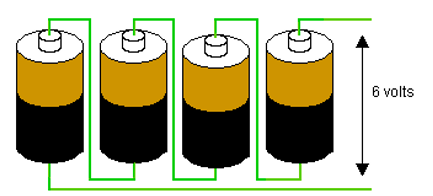
You put batteries together in battery holders. When you place four 1.5 Volt batteries in a battery holder, for example, those batteries combine to produce 6 Volts; when you place six 1.5 Volt batteries in a battery holder, they combine to produce nine Volts; and so on. Batteries are connected in series.
Batteries for longer backup
For many alarm systems that require a 12 Volt supply, you are actually better off using two batteries in parallel than a single battery.
Why? The two batteries last longer than the single battery. The amount of electric current that a battery can generate before it depletes the chemicals it contains varies. Two batteries with cumulatively contains more chemicals than a single battery, and so batteries in parallel lasts longer. (This example assumes that both batteries use the same chemicals. When you use a battery it begins to wear out and the voltage drops; for example, we checked a 12V volt battery that we’d used for a few days and found that it was only producing 11.5 volts under load.
If you have a alarm system that is off grid and you plan to run the gadget all the time, it can eat through batteries. Not the ideal solution or scenario.
- Rechargeable batteries: Some batteries allow you to recharge the, bringing them back almost to their original state of charge.
- Do not recharge non rechargeable bateries. They rapture and leak acid or worse. They can exploded.
How Batteries Work
A battery uses a process called electrochemical reaction to produce a positive voltage at one terminal and a negative voltage at the other terminal. The battery creates these charges by placing two different metals in a certain type of chemical. Because this isn’t a chemistry book, we don’t get into the guts of a battery here.
Batteries have two terminals (a terminal is just a fancy word for a piece of metal to which you can hook up wires). You often use batteries to supply electricity to devices that are portable, such as a flashlight. In a flashlight, the bulb has two wires running to the battery, one to each terminal.
Because the electrons move in only one direction, from the negative terminal through the wires to the positive terminal, the electric current generated by a battery is called direct current, or DC. This contrasts with alternating current (AC) which is discussed later. The wires on a battery must connect to both terminals. This setup allows electrons to flow from one terminal of the battery, through the bulb, and all the way to the other terminal. If the electrons can’t complete this kind of loop between negative and positive, electrons don’t flow.
Battery types
If you buy rechargeable batteries make sure that the battery charger of your alarm system is compatible with the battery type. If you use a incompatible type battery you need to buy a separate charger that is designed for that type of rechargeable battery that you are trying to use. Most Alarm systems use Sealed Lead acid Batteries with a 7AH rating or more.
Some of the readily available battery types use the following chemicals (Not for alarm system usage):
- Zinc-carbon: This type of battery falls at the low quality end of non-rechargeable batteries. Although they don’t cost very much, you have to replace them frequently.
- Alkaline: These batteries last about three times as long as zinc-carbon batteries. When you find yourself doing so many projects that you need to replace these batteries frequently, step up to rechargeable batteries.
- Nickel-cadmium (Ni-Cad or NiCad): This is the most popular type of rechargeable battery. Though many manufacturers have eliminated the problem today, the big flaw with some nickel-cadmium batteries is some thing called the memory effect. With the memory effect, you need to fully discharge the battery before recharging it to insure that it recharges to full capacity. If you don’t discharge it, it doesn’t charge fully. Nickel-cadmium batteries generate about 1.2 volts.
- Nickel-metal hydride (Ni-MH): This type of rechargeable battery generates about 1.2 volts. This battery doesn’t suffer from the memory effect seen in nickel-cadmium batteries. If you decide to use rechargeable batteries, we suggest that you start with these. Buying a recharger and a supply of these batteries saves you a considerable amount of money over time.
- Lithium: If you’re working on a project that requires a lightweight battery, consider lithium. This type of battery generates higher voltage than other types, at about 3 volts. Lithium also has a higher capacity than alkaline batteries. They cost more, and you can’t recharge most batteries of this type. They are typically used in some wireless alarm sensors and accesories
- Don’t worry about whether to use lithium-polymer or lithium-ion batteries. Some battery experts speculate that the manufacturing process for lithium polymer batteries may evolve to produce a better battery in the future.
FAQ
Q: What is the difference between batteries in series and batteries in parallel?
A: Batteries in series increase voltage, while batteries in parallel increase capacity and runtime.
Q: What type of battery is used in alarm systems?
A: Most alarm systems use sealed lead acid (SLA) batteries, typically 12V with a 7Ah rating.
Q: Can you recharge any type of battery?
A: No. Only rechargeable batteries such as NiMH, NiCad, lithium-ion, and SLA can be recharged. Non‑rechargeable batteries can leak or explode if recharged.
Q: Why do rechargeable batteries have lower voltage than alkaline batteries?
A: NiMH and NiCad cells produce about 1.2V due to their chemistry, while alkaline cells produce around 1.5V.
Q: What is direct current (DC)?
A: DC is electricity that flows in one direction, which is how batteries deliver power to devices.