
Conductors: How Electrical Conductors Work in Alarm Systems
Conductors are the pathways that allow electricity to flow where it is needed. In alarm systems, conductors help move charge from the power source to sensors, control panels, and sirens.

What Is a Conductor?
A conductor is a material that allows electricity to flow with minimal resistance. In practice, this means electrons can move more freely inside the material, making it possible for an electric current to flow.
- Conductors provide the path for electric charge
- They allow current to move from source to load
- They reduce energy loss and improve efficiency
Tip: A conductor is usually a metal because metals have free electrons that can move easily.

How Electrons Travel Through Conductors
Electricity is the movement of electrons. In conductors like copper and aluminium, some electrons are not tightly bound to any one atom. These free electrons can drift through the material when a voltage is applied.
In a conductor:
- Atoms have loosely held electrons
- Electrons drift randomly when no field is present
- An outside force, such as voltage, makes the electrons move in one direction
This directed motion of electrons is what we call electrical current.
Why Conductors Matter in Alarm Systems
Alarm systems depend on reliable wiring and low-resistance paths. Good conductors keep the signal strong and reduce the chance of faults.
Common conductor materials include:
- Copper: the most widely used conductor for alarm wiring
- Aluminium: lighter and cheaper, but less conductive than copper
- Silver: the best conductor, but too expensive for most wiring
- Gold: used where corrosion resistance matters, not for general wiring
Insight: For most alarm systems, copper is the best balance of conductivity, cost, and reliability.
Free Electrons: Silver=1 Copper=1, Gold=1 , Aluminum=2
Material micro ohm-cm Silver=1.587, Copper=1.678, Gold=2.214 , Aluminium=2.650
Conductors and Wire Types
Wire is simply a long strand of conductor material. In alarm systems, the two main wire types are solid core and stranded cable.
- Solid core cable– The conductor is a solid piece of metal wire and the gauge of the wire conductor differ depending on the application.
- Stranded wire cable– The conductor consists of 6 or more stranded conductors that make of the gauge of the conductor depending of the application.
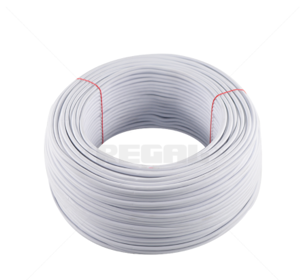
Solid core cable
- Made from a single solid piece of metal
- Easy to insert into terminals
- Best for fixed wiring that does not move often

Stranded cable
- Made from many thin strands twisted together
- More flexible and less likely to break under movement
- Ideal for connections that are handled frequently or need to bend
Warning: Do not use stranded wire in small terminal holes without twisting the strands tightly first. Loose strands can short out a circuit.
With alarm systems we have 2 types off conductors. We can use solid core or stranded cable. It is recommended to consult the manufacturer’s specifications and guidelines when choosing the conductor type and gauge for an alarm system. Additionally, it is important to ensure that the conductor type and gauge is selected for the application.
The wire that you use in projects is just a long strand of metal, usually made of copper. The wire has only one job — to allow electrons to travel through it. However, you can find a few variations in the types of wire available to you.
You use stranded wire in projects where the wire will be moved around or for data transmission over longer distances. For example, you use stranded wires for multimeter leads because you move and flex the leads frequently. If you use a solid wire, it snaps in two after you flex it several times.
Use solid wire to connect components to the alarm system and other places where you don’t plan to move the wire around. You can easily insert the solid wire into holes or terminals, and that wire stays in the shape to which you mold it.
If you try to use a stranded wire in a small terminal connection, you have to twist the strands to get all of them in the hole, and you may break a strand which could short out the circuit.
Understanding Wire Gauge
Wire gauge is the standard way to describe wire size. It relates to the wire’s diameter, but the numbering is backwards:
- Smaller gauge number = larger wire diameter
- Larger gauge number = smaller wire diameter
This naming comes from the wire drawing process: thinner wire requires more drawing steps through smaller holes.
What’s confusing is that the relationship between wire gauge and wire diameter is essentially backwards. A smaller wire gauge means a larger wire diameter. Manufacturers saddled us with this backwards-naming scheme because of the manufacturing process they use for wires. To make a wire, the metal (usually copper) is pulled through a hole in a steel plate. To make a small diameter wire, the wire is pulled through a series of holes, each hole smaller than the previous one. The wire gauge refers to the number of different size holes the wire was pulled through to make the desired diameter. So the higher the number, the more times someone had to pull the wire and the smaller that wire got in the process.
Conductivity and Material Properties
Some materials conduct electricity much better than others. Here are typical resistance values for common metals, measured in micro-ohm centimetres:
- Silver: 1.587 µΩ·cm
- Copper: 1.678 µΩ·cm
- Gold: 2.214 µΩ·cm
- Aluminum: 2.650 µΩ·cm
Note: Lower resistance means better conductivity. That is why copper is the preferred choice for most alarm system wiring.
Conclusion
Conductors are the backbone of any electrical system, including alarm installations. They guide current along a safe path and keep systems working efficiently. By choosing the right conductor type and wire gauge, you can make alarm wiring more reliable and easier to maintain.